
Posted on 9 Feb 2026
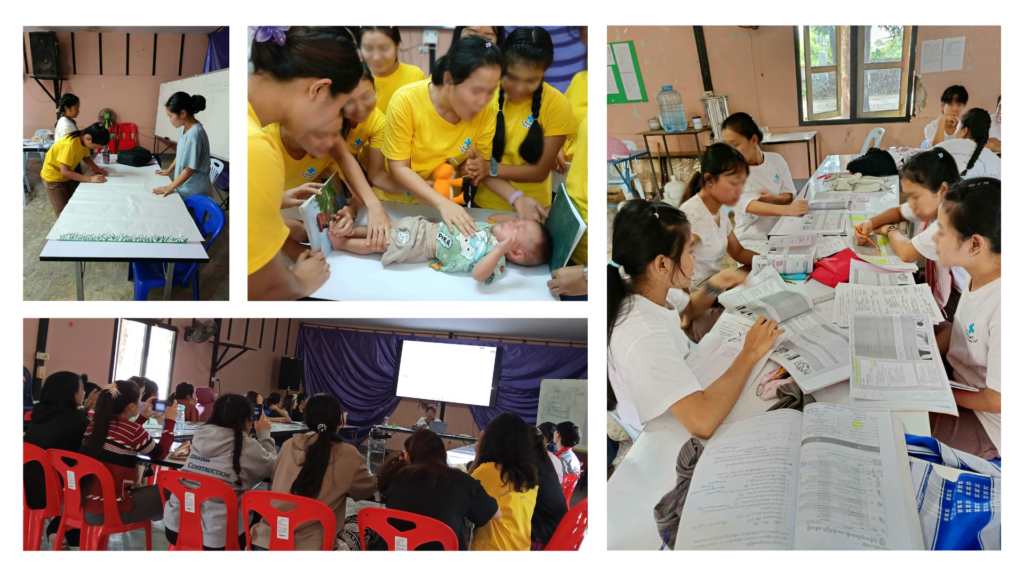
Aye Aye and Moh Moh (pseudonyms) recently attended a maternal and child health (MCH) training at BPHWT’s head office. Both are in their early twenties and were first-year university students before their education was disrupted by political instability and armed conflict in Burma.
Although they come from the same state, they had never met before this training. Their paths into health care, while different, were shaped by the same urgent need in their communities.
Aye Aye was first trained as a nurse aide in Yangon, a major city of Burma, before joining BPHWT as a nurse aide. She first encountered BPHWT when the organization opened a clinic in her village, an experience that inspired her to join the team. She served her community for three years before attending this MCH training.
Moh Moh entered health care more recently. She joined BPHWT as a community health worker and completed a six-month community health worker training. After serving her community for four months, she was selected to attend the MCH training.
Despite coming from the same state, their working environments are vastly different.
Aye Aye works in a highly conflict-affected area with very few skilled health workers. The clinic is staffed by only three health workers: Aye Aye and two community health workers with basic skills. Together, they provide care for the village where the clinic is based, as well as for patients traveling from surrounding areas. Poor road conditions make travel extremely difficult, and many patients must travel long distances to reach care either by motorcycle for one and a half to three hours or on foot. As a result, it is especially difficult for pregnant women from these areas to visit the clinic regularly, particularly during their later trimesters.
During her three years of service, the clinic was completely destroyed twice, once by airstrikes and once by fire intended to destroy the entire village. Each time, the clinic had to be rebuilt. Even now, there is no separate delivery room. Aye Aye shared that a dedicated delivery room would allow the clinic to provide better maternal and child health care and encourage pregnant women to come to the clinic to deliver rather than giving birth at home.
Moh Moh works in a relatively safer area, though it is not free from fear. When aircraft are heard overhead, health workers and community members fear the possibility of airstrikes. Her clinic has more skilled health workers, both on site and in nearby areas, which eases the pressure of patient care. Unlike Aye Aye’s clinic, Moh Moh’s facility has a separate delivery room, and nearby smaller clinics also have designated spaces for delivery.
Both women deeply appreciated the opportunity to attend the MCH training. The program lasted 11 months and combined classroom learning with practical, hands-on experience, including antenatal care, safe delivery practices, postnatal care, newborn care, management of common maternal and child health complications, and integrated management of childhood illnesses. During their practical training period, Aye Aye had the opportunity to independently deliver 15 babies, and Moh Moh had the opportunity to independently deliver 8 babies. These experiences strengthened their confidence and skills to provide life-saving care in their communities.
Looking ahead, Aye Aye aspires to become an Emergency and Obstetric Care worker. Moh Moh hopes to become a medic. Both are determined to continue serving their communities despite the challenges they face.
BPHWT aims to deliver MCH training on an annual basis, with the current cohort representing the fifth batch of trainees. The MCH training program began in 2011 and was paused after two cohorts due to operational constraints. During this period, health workers were sent to receive MCH training from ethnic partner organizations. It was successfully relaunched in 2022 with an updated curriculum. To date, BPHWT has trained approximately 125 MCH workers, helping to address critical gaps in maternal and child health care in conflict-affected, underserved, and hard-to-reach areas of Burma.